There have been significant changes in the nickel downstream industry in Indonesia since Jokowi took office. The focus on nickel downstreaming has become an important strategy to increase product value-added and drive the economy, especially with the rapid growth of the electric vehicle battery industry worldwide.
With nickel being a key component in battery production, including the increasingly popular electric vehicle batteries, efforts in nickel downstreaming have become increasingly important. Unfortunately, this not only opens up opportunities for job creation and domestic industrial growth but also brings about many negative impacts. One of them is the potential loss of forests due to nickel mining.
South Sulawesi is one of the regions in Indonesia known for its significant nickel reserves. The first nickel mining operation in Indonesia was conducted by PT Vale (formerly known as INCO) in Sorowako, South Sulawesi. This mining activity has been ongoing for several decades. Presently, according to government publications, there are 13 issued nickel mining permits in South Sulawesi. [1]
Tabel 1. List of nickel mining concessions in South Sulawesi until March 2024
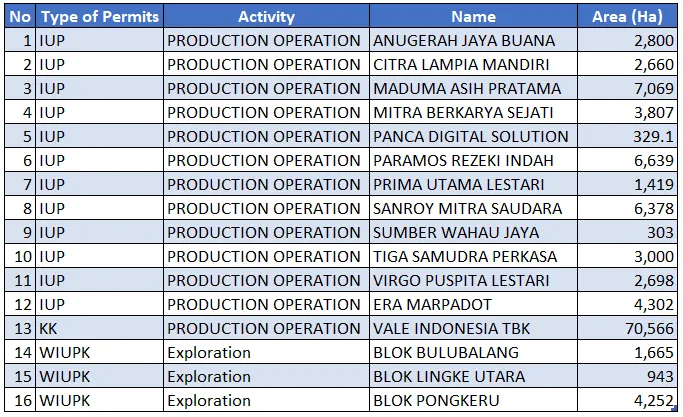
Out of the thirteen permits mentioned, five were issued in the last two years. In 2023, the government issued permits to PT Anugerah Jaya Buana, PT Paramos Rezeki Indah, and PT Mitra Berkarya Sejati, all in July. This year, the government granted permits to PT Maduma Asih Pratama and PT Era Marpadot. This confirms that the Indonesian government is very welcoming to investment in the nickel mining sector.
Additionally, the government is currently auctioning the Pongkeru block.
In Indonesia, “forest area” refers to land managed by the Ministry of Environment and Forestry (KLHK). Therefore, it doesn’t always imply that the land is covered by forest ecosystems; it is also known as state forest area. For additional information, for any mining activities in the state forest area, the mining company must obtain a license from the Ministry of Environment and Forestry.
Nevertheless, every year the Ministry of Environment and Forestry also publishes a land cover map. This data is based on satellite image interpretation. In this context, the Ministry of Environment and Forestry classifies forests on dry land into two categories: primary forest and secondary forest. Primary forest is forest that grows and develops in dry land habitats, which can include lowland, hilly and mountainous forests, or highland tropical forests. These forests are still intact and have not experienced human intervention or shown traces of logging. Meanwhile, secondary forest is forest that is growing and developing in dry land habitats, which can include lowland forests, hills and mountains, or highland tropical forests, and has experienced human intervention or shows visible logging scars, such as furrows and logging spots.
This study focuses on assessing the potential loss of forest ecosystems. To analyze this, the data utilized is the latest land cover map from 2022 issued by the Ministry of Environment and Forestry.[2]
The analysis of the overlap between nickel mining permits and land cover indicates that a total of 70.925,86 hectares of forest are at risk of being lost. This includes 15.675,68 hectares of primary forest and 55.250,18 hectares of secondary forest.
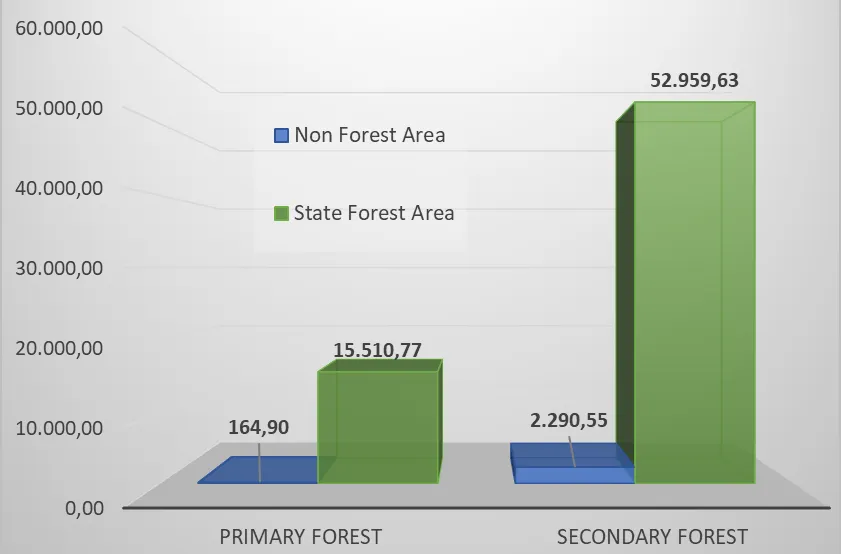
So out of the total 118,830 hectares of mining permits for production and exploration operations, 70 thousand hectares are areas covered by forests.
Out of the 70 thousand hectares of forest threatened by nickel mining above, 97 percent of them are within state forest areas, meaning companies cannot immediately conduct mining in these forest ecosystems without obtaining approval from the Ministry of Environment and Forestry. Meanwhile, the remaining 3 percent located in non-state forest area can be directly mined by companies, provided they adhere to the locations of annual mining plan blocks approved by the Ministry of Energy and Mineral Resources.
Although many forests fall under the authority of the Ministry of Environment and Forestry, this ministry is not anti-mining. For example, PT Vale Indonesia has obtained permits for 56.108 hectares of state forest land from KLHK. Of this total area, 29.168 hectares are located in South Sulawesi, divided into three approval permits.[3]
In addition, companies granted approval to use state forest areas are required to rehabilitate watersheds outside their permit areas as compensation land. Unfortunately, this concept is similar to carbon trading, which many critical environmental activist consider to be greenwashing. Why? Because rehabilitation in other areas certainly cannot replace the ecological functions of forests lost to mining. Furthermore, although companies are obligated to conduct reclamation in mining areas, it cannot fully restore the original functions. This is especially true if the mined forests have high biodiversity and important ecological functions.
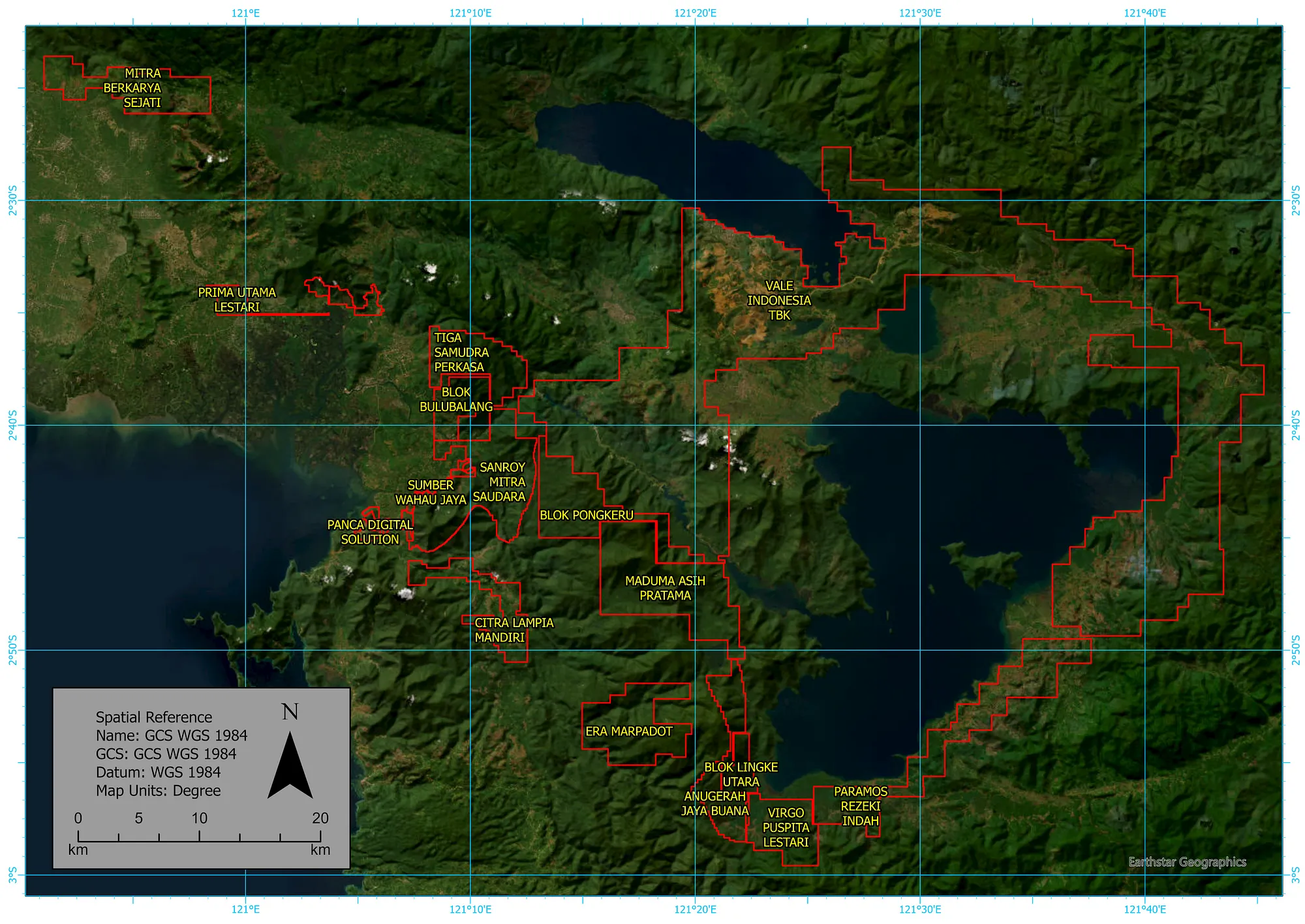
What is concerning is that, as seen on the map above, nickel mining permits surround and/or are located near three ancient lakes in South Sulawesi: Lake Towuti, Lake Matano, and Lake Mahalona. Lake Matano is the deepest lake in Indonesia and Southeast Asia, with a depth of approximately 590 meters. [4]
If the surrounding forests are not preserved and nickel mining continues, these three ancient lakes face the threat of environmental degradation.
This simple article aims to highlight the loss of forests; however, the reality on the ground is that many communities are at risk of becoming victims of nickel mining ambitions. They face the loss of their homes, livelihoods, and the right to a healthy environment.
Therefore, I believe it is crucial to uphold the rights of all those affected and to ensure that no one is sacrificed for any reason, including the energy transition.
— -
[1] ESDM One Map — Exploring Energy and Mineral Resources of Indonesia https://geoportal.esdm.go.id/minerba/
[2] SIGAP — Sistem Informasi Geospasial Kementerian Lingkungan Hidup dan Kehutanan https://geoportal.menlhk.go.id/Interaktif2/
[3] PT Vale Indonesia Sustainability Report 2023 — https://vale.com/documents/d/guest/pt-vale-laporan-keberlanjutan-2023-eng
[4] Nakano, Shin-ichi & Yahara, Tetsukazu & Nakashizuka, Tohru. (2016). Aquatic Biodiversity Conservation and Ecosystem Services. 10.1007/978–981–10–0780–4.