Introduction
The climate crisis has become one of the defining challenges of this century. In 2024, the global temperature anomaly reached approximately +1.55°C above the pre-industrial period, making it the first year to exceed the 1.5°C warming threshold. The year was also recorded as the hottest year in history. Rising global temperatures have intensified hydrometeorological disasters, including floods, landslides, droughts, food crises, sea-level rise, and widespread economic losses.
In this context, the energy transition has become an urgent global agenda. Fossil fuel-based energy systems remain the largest contributor to global greenhouse gas emissions, accounting for around 73–75% of total emissions. As a result, we need accelerating efforts to reduce dependence on coal, oil, and gas, while expanding renewable energy, electrifying transportation, improving energy efficiency, and pursuing net-zero emissions targets by mid-century.
However, the energy transition does not only require a shift in energy sources. It also requires a massive increase in mineral extraction. Clean energy technologies such as electric vehicles, energy storage batteries, power grids, wind turbines, and energy infrastructure depend on large supplies of critical minerals. Nickel, lithium, and cobalt are needed for electric vehicle batteries; rare earth elements are used in wind turbines and electric motors; copper is essential for electricity grids and transmission systems; while aluminium and steel support the construction of energy infrastructure.
Among these minerals, **nickel ** holds a particularly strategic position. Nickel is widely used in stainless steel, industrial alloys, and increasingly in electric vehicle batteries, especially NMC and NCA battery chemistries. Global demand projections indicate that nickel demand could increase by around 3.4 times by 2050. The fastest growth is expected to come from the battery sector, particularly precursor cathode active materials, or PCAM, with demand projected to grow by around 17.2% per year, far higher than demand growth from stainless steel, estimated at around 4% per year.
Indonesia stands at the center of this transformation. The country holds approximately 42–44% of the world’s nickel reserves and, in 2024, produced around 2.31 million tonnes of nickel, equivalent to approximately 62% of global nickel production, which reached 3.71 million tonnes. With this position, Indonesia is not only a supplier of raw materials but also a central node in the global supply chain for electric vehicles and clean energy technologies.
Indonesia’s role has become even more significant due to the rapid expansion of nickel downstreaming, especially through the construction of processing facilities, or smelters. Nickel smelting capacity in Indonesia is highly concentrated in Sulawesi and North Maluku. These two regions have become the main hubs of national nickel industrialization, supporting the production of ferronickel, nickel pig iron, nickel matte, and battery-related materials.
In Sulawesi, nickel processing capacity is substantial and dominated by RKEF technology, or Rotary Kiln Electric Furnace. In Central Sulawesi, there are 15 RKEF facilities with a total capacity of around ±602,000 tonnes Ni-equivalent, alongside 2 HPAL facilities with a capacity of around ±85,000 tonnes Ni-equivalent, and 1 matte converter with a capacity of around ±30,000 tonnes Ni-equivalent. In South and Southeast Sulawesi, there are 6 RKEF facilities with a capacity of around ±452,000 tonnes Ni-equivalent, and 1 matte converter with a capacity of around ±71,000 tonnes Ni-equivalent. Combined, Sulawesi’s nickel processing capacity reaches approximately ±1.24 million tonnes Ni-equivalent.
In North Maluku, nickel processing capacity is also significant. The region has 18 RKEF facilities with a capacity of around ±639,000 tonnes Ni-equivalent, and 2 HPAL facilities with a capacity of around ±94,000 tonnes Ni-equivalent. In total, North Maluku’s nickel processing capacity reaches approximately ±733,000 tonnes Ni-equivalent. The dominance of RKEF indicates that most processing capacity is still oriented toward pyrometallurgical production, while the presence of HPAL facilities reflects the growing orientation toward battery-grade nickel materials.
The concentration of mines and smelters in Sulawesi and Maluku shows that the global energy transition has a very concrete geographical footprint in Indonesia. On one hand, nickel is positioned as a key mineral for decarbonization. On the other hand, the expansion of nickel mining and processing facilities is increasing pressure on forests, coastal areas, small islands, Indigenous territories, and ecologically valuable landscapes.
For this reason, nickel should not be understood merely as a strategic commodity for the energy transition. It must also be seen as part of a broader spatial transformation with significant socio-ecological consequences. The central question is not only how Indonesia can supply nickel for the global low-carbon economy, but also how this expansion can be prevented from sacrificing tropical forests, biodiversity, and local communities living around mining and industrial processing zones.
Methodology
This analysis uses a spatial approach based on Geographic Information Systems (GIS) to identify the relationship between nickel mining expansion and forest ecosystem risks in Indonesia.
Two main datasets were used in this analysis. First, the analysis uses 2026 nickel mining licensing data, updated as of February 2026. This dataset includes the spatial boundaries of nickel mining permits in Indonesia, including exploration permits, production operation permits, and auction areas.
Second, the analysis uses 2024 forest cover data published by Indonesia’s Ministry of Environment and Forestry (KLHK). This dataset classifies forest ecosystems, including primary forest, secondary forest, primary mangrove, secondary mangrove, primary swamp forest, and secondary swamp forest.
Through a spatial overlay process, nickel mining concession boundaries were intersected with KLHK forest cover data. This process identifies forest areas located inside nickel mining concessions. These areas are classified as forest areas under threat, because they are legally and spatially located within mining permit boundaries and may therefore be exposed to future land clearing, degradation, fragmentation, or land-use conversion.
It is important to note that this analysis does not only measure areas that have already been cleared through open-pit mining. It also captures broader ecological risks, namely forests that remain standing but are located inside nickel mining concessions and are therefore vulnerable to future mining expansion.
National Overview
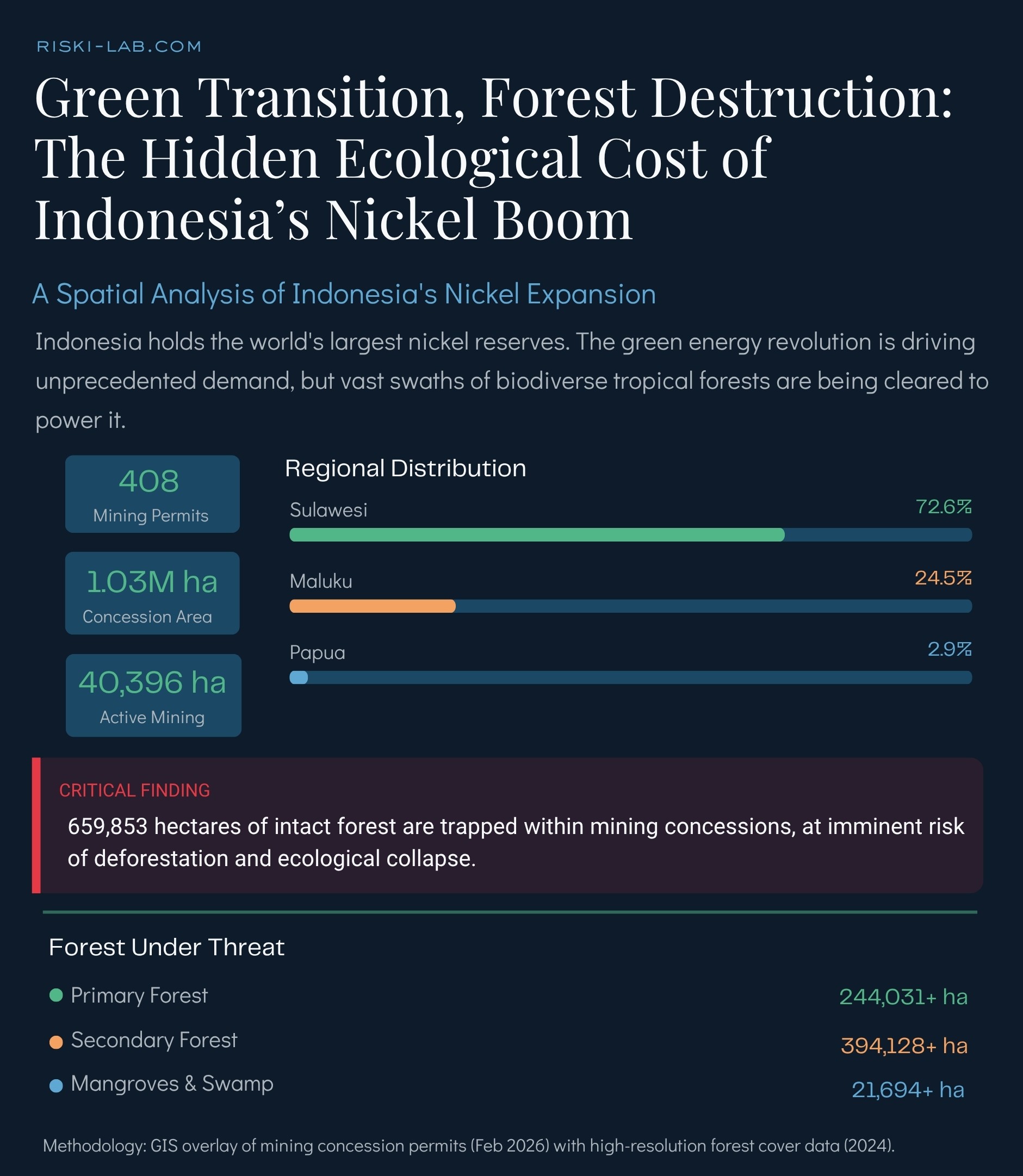
At the national scale, Indonesia’s nickel mining expansion already covers a very large area. The data shows that there are 408 nickel mining permits with a total concession area of 1,026,674.31 hectares. Within these concessions, open-pit mining areas have reached 40,396.43 hectares, spread across 215 permits.
The most important finding of this analysis is the extent of forest ecosystems located inside nickel mining concessions. In total, approximately 659,852.8 hectares of forest areas are under threat across the three main regions: Sulawesi, Maluku, and Papua. These forests include primary forest, secondary forest, mangrove, and swamp ecosystems.
In other words, the visible footprint of existing open-pit mining represents only a small portion of the larger ecological risk. The greater threat lies in the remaining forests inside mining concessions, which may be fragmented or converted as mining operations and supporting infrastructure expand.
Regional Findings
1. Sulawesi: The Epicenter of Indonesia’s Nickel Extraction
Sulawesi is the main center of Indonesia’s nickel expansion. The region has the largest number of permits and the widest concession area compared to other regions. There are 339 nickel mining permits in Sulawesi, covering a total area of 745,577.36 hectares. Of these, 336 permits are production operation permits covering 738,717.36 hectares, while 3 permits are exploration permits covering 6,860 hectares.
With this concession area, Sulawesi accounts for approximately 72.6% of Indonesia’s total nickel concession area. The region also contains more than 80% of all nickel mining permits recorded nationally. This confirms Sulawesi’s position as the epicenter of national nickel industrialization.
In terms of active open-pit mining, Sulawesi is also the most heavily affected region. Open-pit mining areas in Sulawesi cover 30,247.71 hectares across 180 permits. This indicates that most active extraction is concentrated in this region.
The ecological risk is severe. The overlay analysis shows that 461,248.82 hectares of forest areas are under threat inside nickel concessions in Sulawesi. This includes 227,031.16 hectares of primary forest, 232,346.85 hectares of secondary forest, 87.83 hectares of primary mangrove, 1,277.70 hectares of secondary mangrove, 376.526 hectares of primary swamp forest, and 128.75 hectares of secondary swamp forest.
Sulawesi is therefore not only the center of nickel production, but also the center of ecological risk associated with Indonesia’s nickel expansion. The growth of mines, industrial parks, roads, ports, and smelters is intensifying pressure on forests, coastal areas, water systems, and the living spaces of local and Indigenous communities.
2. Maluku: Fragmentation of Island Ecosystems
Maluku is the second-largest region in Indonesia’s nickel expansion. The region, particularly North Maluku, has become one of the most important centers of national nickel industrial growth through the development of large-scale mines and processing facilities.
The data shows that Maluku has 67 nickel mining permits with a total area of 251,490.95 hectares. These consist of 61 production operation permits covering 239,179.75 hectares, 3 exploration permits covering 8,379.2 hectares, and 2 auction areas covering 3,932 hectares.
Open-pit mining areas in Maluku have reached 9,850.61 hectares across 34 permits. Although this area is smaller than in Sulawesi, the ecological consequences are significant because Maluku consists of island landscapes where forests, watersheds, coastal areas, and communities are closely interconnected.
The overlay analysis shows that 179,969.34 hectares of forest areas are under threat inside nickel concessions in Maluku. This includes 17,356.86 hectares of primary forest, 161,782.55 hectares of secondary forest, 766.14 hectares of primary mangrove, and 63.78 hectares of secondary mangrove.
The largest threat in Maluku is to secondary forests, but the presence of primary forests and mangroves inside nickel concessions indicates that nickel expansion may also affect ecosystems with high conservation value. In the context of small and medium-sized islands, forest clearing can accelerate habitat fragmentation, disrupt hydrological systems, increase sedimentation into coastal waters, and intensify pressure on local and Indigenous communities.
3. Papua: A Vulnerable Nickel Frontier
Papua currently has a smaller nickel mining footprint compared to Sulawesi and Maluku. However, the region has exceptionally high ecological value because it forms part of one of the largest and most intact tropical forest landscapes in the world.
The data shows that Papua has 2 nickel mining permits covering a total area of 29,606 hectares. These consist of 1 exploration permit covering 16,470 hectares and 1 production operation permit covering 13,136 hectares.
Open-pit mining areas in Papua remain relatively limited, covering 298.10 hectares under 1 permit. However, the forest area located inside these concessions is substantial relative to the small number of permits. The overlay analysis identifies 18,634.64 hectares of forest areas under threat in Papua. This includes 6,958.51 hectares of primary forest, 11,348.30 hectares of secondary forest, 132.82 hectares of primary swamp forest, and 195.01 hectares of secondary swamp forest.
Papua should therefore be understood as a highly vulnerable frontier. The limited current mining footprint does not mean that the risk is low. On the contrary, if nickel expansion in Papua follows the pattern already seen in Sulawesi and Maluku, the ecological consequences could be severe, especially for primary forests, biodiversity, carbon stocks, and Indigenous territories.
Conclusion
This analysis shows that Indonesia’s nickel expansion has a vast ecological footprint. Nationally, there are 408 nickel mining permits covering more than one million hectares of concessions. Within these areas, more than 40,000 hectares have already become open-pit mining areas, while nearly 660,000 hectares of forest ecosystems are under threat because they fall inside nickel mining concessions.
Sulawesi is the epicenter of nickel extraction, with the largest concession area, the highest number of permits, the widest open-pit mining footprint, and the largest area of forest under threat. Maluku represents the next major center of expansion, with significant risks to island ecosystems, secondary forests, primary forests, and mangroves. Papua, despite its currently smaller mining footprint, is a highly vulnerable ecological frontier for future nickel expansion.
These findings reveal a fundamental contradiction within the global energy transition. Nickel is indeed an important mineral for electric vehicles, batteries, and clean energy technologies. However, if its extraction comes at the expense of tropical forests, mangroves, swamp ecosystems, biodiversity, and Indigenous territories, then the energy transition risks reproducing the same extractive logic that has long characterized the fossil fuel economy.
A just energy transition cannot be measured only by emissions reductions at the point of consumption. It must also be assessed by how transition minerals are extracted, where they come from, who bears the impacts, and which ecosystems are sacrificed. In Indonesia, forest protection and the rights of local communities must become central prerequisites for any agenda of nickel downstreaming and expansion.
Ultimately, the key question for the future of the energy transition is not only whether the world can move away from fossil fuels toward clean energy. It is also whether this transition can be achieved without destroying the forests that sustain the climate, biodiversity, and the lives of local communities.